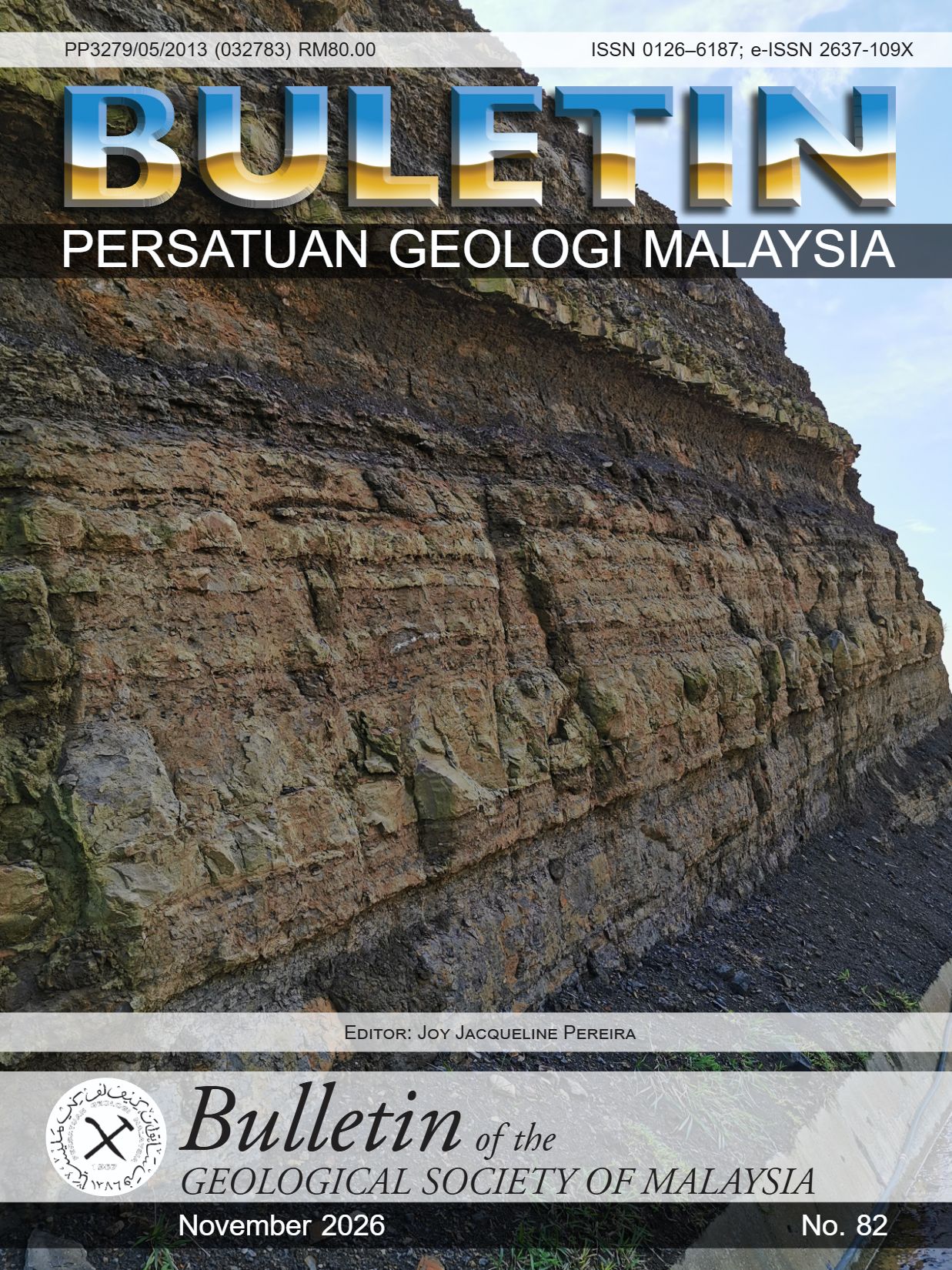

Bulletin of the Geological Society of Malaysia, Volume 82, November 2026, pp. 113-125
Morphological characterization of a weathering profile over orthopyroxene rhyodacite in Malaysia
John Kuna Raj
No. 83, Jalan Burhanuddin Helmi 2, Taman Tun Dr. Ismail, 60000 Kuala Lumpur, Malaysia
Email address: jkr.ttdi.tmc@gmail.com
Abstract: Variations in morphological features, considered to reflect differences in the extent of weathering of an orthopyroxene rhyodacite, allowed differentiation of two broad zones at the profile, i.e. an upper pedological soil (zone I), some 12.2 m thick of sandy clays, and a lower, >32.2 m thick, saprock (zone II) of silty sands with indistinct to distinct, relict bedrock textures and structures. The pedological soil comprises soil horizons A, B and C, whilst the saprock is separated into four sub-zones IIA, IIB, IIC and IID in view of differences in preservation of joint, banding and fault planes and the content of core-boulders. The exposed weathered bedrock materials have porosities of 39% to 53%, and dry densities of 1211 to 1574 kg/m3, whilst the soil particles have a specific gravity between 2.57 and 2.62. Particle size distributions are variable with depth; the pedological soil with large clay (>27%) but low silt (<30%) fractions, and the saprock with large silt (>26%) but low clay (<26%), fractions. Sand fractions are variable (23-60%) and gravel fractions minimal (<9%). Increasing clay, but decreasing silt, fractions up the profile indicate increasing alteration of bedrock material; a feature reflected by increasing values of the textural weathering index (Iw). Weathering zone I (pedological soil) is correlated with grade, or class, VI of standard rock mass weathering classifications, whilst sub-zones IID and IIC are equated with grades, or classes, III, and IV, respectively, and sub-zones IIA and IIB with grade, or class, V. It is concluded that field differentiated, weathering zones and sub-zones can be equated with standard rock mass weathering grades or classes, and have the advantage that they allow recognition of indistinctly to distinctly preserved, relict bedrock structures.
Keywords: Orthopyroxene rhyodacite, weathering profile, pedological soil, saprock, rock mass weathering grade, rock mass class
References
Alavi, S.V.N.K., Tugrul, A., Gokceoglu, C., & Armaghani, D.J., 2016. Characteristics of weathering zones of granitic rocks in Malaysia for geomechanical engineering design. Engineering Geology, 200, 94-103.
Aydin, A., 2006. Stability of saprolitic slopes: nature and role of field scale heterogeneities. Natural Hazards and Earth System Science, 6, 89-96.
Aydin, A., Duzgoren-Aydin, N.S., & Malpas, J., 2000. A review of igneous and metamorphic saprolites. Journal of Nepal Geological Society, 22, 11-16.
Aydin, A. & Wen, B.P., 2003. Microstructural study of a natural slip zone, quantification and deformation history. Engineering Geology, 68, 289-317.
Azman, A.G., & Singh, N., 2005. Petrology and geochemistry of the Sempah Volcanic Complex. Bulletin of the Geological Society of Malaysia, 51, 103-121.
Bonnet, M., Caner, L., Siitari-Kauppi, M., Mazurier, A., Mexias, A.S., Dani, N., & Sardini, P., 2022. Weathering of Viamão granodiorite, South Brazil: Part 1 – Clay minerals formation and increase in total porosity. Geoderma, 424,115968.
Bonnet, M., Caner, L., Siitari-Kauppi, M., Mazurier, A., Mexias, A.S., Dani, N., & Sardini, P., 2023. Weathering of Viamão granodiorite, South Brazil: Part 2 – Initial porosity of un-weathered rock controls porosity development in the critical zone. Geoderma, 429,116247.
Carroll, D., 1970. Rock Weathering. Plenum Press, New York. 203 p.
Cobbing, E.J., & Mallick, D.I.J., 1987. Southeast Asia Granite Project – Field Report for Peninsular Malaysia. British Geological Survey, Report No. MP/87/19R. Overseas Directorate, 29 p.
Dearman, W.R., 1976. Weathering classification in the characterization of rock – A review. Bulletin International Association Engineering Geology, 13, 23-127.
Deere, D.V., & Patton, F.D., 1971. Slope stability in residual soils. Proceedings 6th Pan-American Conference Soil Mechanics & Foundation Engineering Puerto Rico, 1, 87-170.
GCO, Geotechnical Control Office, 1988. Guide to Rock and Soil Descriptions, Geoguide 3. Geotechnical Control Office, Hong Kong. 186 p.
GSL, Geological Society of London, 1990. Tropical residual soils. Geological Society Working Group Report, Quarterly Journal of Engineering Geology, 23, 1-102.
Graham, R.C., Rossi, A.M., & Hubbert, K.R., 2010. Rock to regolith conversion: Producing hospitable substrates for terrestrial ecosystems. GSA TODAY, 20(2), 4-9. doi: 10.1130/GSAT57A.1.
Haile, N.S., Stauffer, P.H., Krishnan, D., Lim, T.P., & Ong, G.B., 1977. Palaeozoic redbeds and radiolarian cherts: reinterpretation of their relationships in the Bentong and Raub areas, West Pahang, Peninsular Malaysia. Bulletin of the Geological Society of Malaysia, 8, 45-60.
IAEG, International Association on Engineering Geology, 1981. Rock and soil description and classification for engineering geological mapping. Bulletin International Association Engineering Geology, 24, 235-274.
ISRM, International Society for Rock Mechanics, 1981. Suggested methods for rock characterization testing and monitoring. Brown E.T. (Editor), Pergamon Press, Oxford. 211 p.
ISRM, International Society for Rock Mechanics, 2007. ISRM suggested methods for rock characterization, testing and monitoring: 1974–2006. R. Ulusay & J. Hudson (Editors). International Society for Rock Mechanics, Ankara. 628 p.
ISRM, International Society for Rock Mechanics, 2015. The ISRM Suggested Methods for Rock Characterization, Testing and Monitoring: 2007-2014, 2015 Edition. In: R. Ulusay (Ed.), International Society for Rock Mechanics, Ankara. 211 p.
JKR, Jabatan Kerja Raya Malaysia (Public Works Department Malaysia), 2007. Guidelines for hard material/rock excavation. Technical Note (Roads) 24/05, Road Division Jabatan Kerja Raya Malaysia. 15 p.
Jaques, D.S., Marques, E.A.G., Marcellino, L.C., Leao, M.F., & Coelho, V.d.S.C., 2021. Morphological and mineralogical characterization of weathering zones in tropical climates: A basis for understanding the weathering process on granitic rocks in southeastern Brazil. Journal of South American Earth Sciences, 108, article 103187. doi:10.1016/j.jsames.2021.103187.
Lan, H.X., Hu, R.L., Yue, Z.Q., Fee, C.F., & Wang, S.J., 2003. Engineering and geological characteristics of granite weathering profiles in South China. Journal Asian Earth Sciences, 21, 353-364.
Leao, M.F., & Marques, E.A.G., 2016. Morphology and geotechnical characterization of a phyllite weathering profile developed under tropical climate. In: Lehane, Acosta-Martinez & Kelly (Eds.), Geotechnical and Geophysical Site Characterization 5, Australian Geomechanics Society, Sydney, Australia. ISBN 978-0-9946261-2-7.
Liew, T.C., 1977. Petrology and structural relationships of rhyolitic rocks and micro-granodiorite, east of Genting Sempah, Pahang. B.Sc. Dissertation, Department of Geology, University of Malaya, Kuala Lumpur. 65 p.
Little, A.L., 1969. The engineering classification of residual tropical soils. Proceedings 7th International Conference Soil Mechanics & Foundation Engineering, Mexico, 1, 1-10.
Mandisodza, K.T., & Dunn, M.J., 2019. Geotechnical design and uncertainty in residual soil slope. In: J. Wesseloo (Ed.), MGR 2019: Proceedings of the First International Conference on Mining Geomechanical Risk. Australian Centre for Geomechanics, Perth, pp. 475-492. https://doi.org/10.36487/ACG_rep/1905_29_Mandisodza.
Munsell, 2009. Soil Colour Charts. Munsell Colour Company.
Ollier, C.D., 1969. Weathering. Oliver & Boyd, Edinburgh. 304 p.
Phillips, J.D., & Lorz, C., 2008. Origins and implications of soil layering. Earth Science Reviews, 89, 144-155.
Rahardjo, H., Aung, K.K., Leong, E.C., & Rezaur, R.B., 2004. Characteristics of residual soils in Singapore as formed by weathering. Engineering Geology, 73, 157-169.
Raj, J.K., 1985. Characterization of the weathering profile developed over a porphyritic biotite granite bedrock in Peninsular Malaysia. Bulletin International Association Engineering Geology, 32, 121-128.
Raj, J.K., 2018. Physical characterization of a deep weathering profile over rhyolite in humid tropical Peninsular Malaysia. Geotechnical & Geological Engineering, 36, 3793-3809.
Raj, J.K., 2023. Physical characterization of the weathering profile over a sheared, biotite-muscovite granite in Peninsular Malaysia. Bulletin of the Geological Society of Malaysia, 75, 25-36.
St. John, B.J., Sowers, G.F., & Weavers, C.H.E., 1969. Slickensides in residual soils and their engineering significance. Proceedings 7th International Conference on Soil Mechanics & Foundation Engineering, II, 591-597.
Swart, D., & Dippenaar, M.A., 2025. Weathering profile of completely weathered rock from the Dullstroom Formation, South Africa. Bulletin of Engineering Geology and the Environment, 84, 223.
Tandarich, J.P., Darmody, R.G., Follmer, L.R., & Johnson, D.L., 2002. Historical development of soil and weathering profile concepts from Europe to the United States of America. Journal Soil Science Society of America, 66, 335-346.
Tan, Y.C., & Gue, S.S., 2001. The determination of shear strength in residual soils for slope stability analysis. Seminar Cerun Kebangsaan 2001, Cameron Highlands, 14-15 May 2001.
Thomas, M.F., 1974. Tropical Geomorphology – A Study of Weathering and Landform Development in Warm Climates. MacMillan Press Ltd., New York. 332 p. ISBN 0333033132.
Thorez, J., 1975. Phyllosilicates and Clay Minerals – A Laboratory Handbook for Their X-Ray Diffraction Analysis. G. Lelotte, Belgium. 582 p.
Wesley, L., 2009. Behavior and geotechnical properties of residual soils and allophane clays. Obras y Proyectos, 6, 5-10.
Wesley, L., 2011. Stability of slopes in residual soils. Obras y Proyectos, 10, 47-61.
Manuscript received 17 November 2025;
Received in revised form 22 January 2026;
Accepted 24 February 2026
Available online 27 November 2026
https://doi.org/10.7186/bgsm82202610
0126-6187; 2637-109X / Published by the Geological Society of Malaysia.
© 2026 by the Author(s). This is an open access article distributed under the terms of the Creative Commons Attribution (CC-BY) License 4.0.