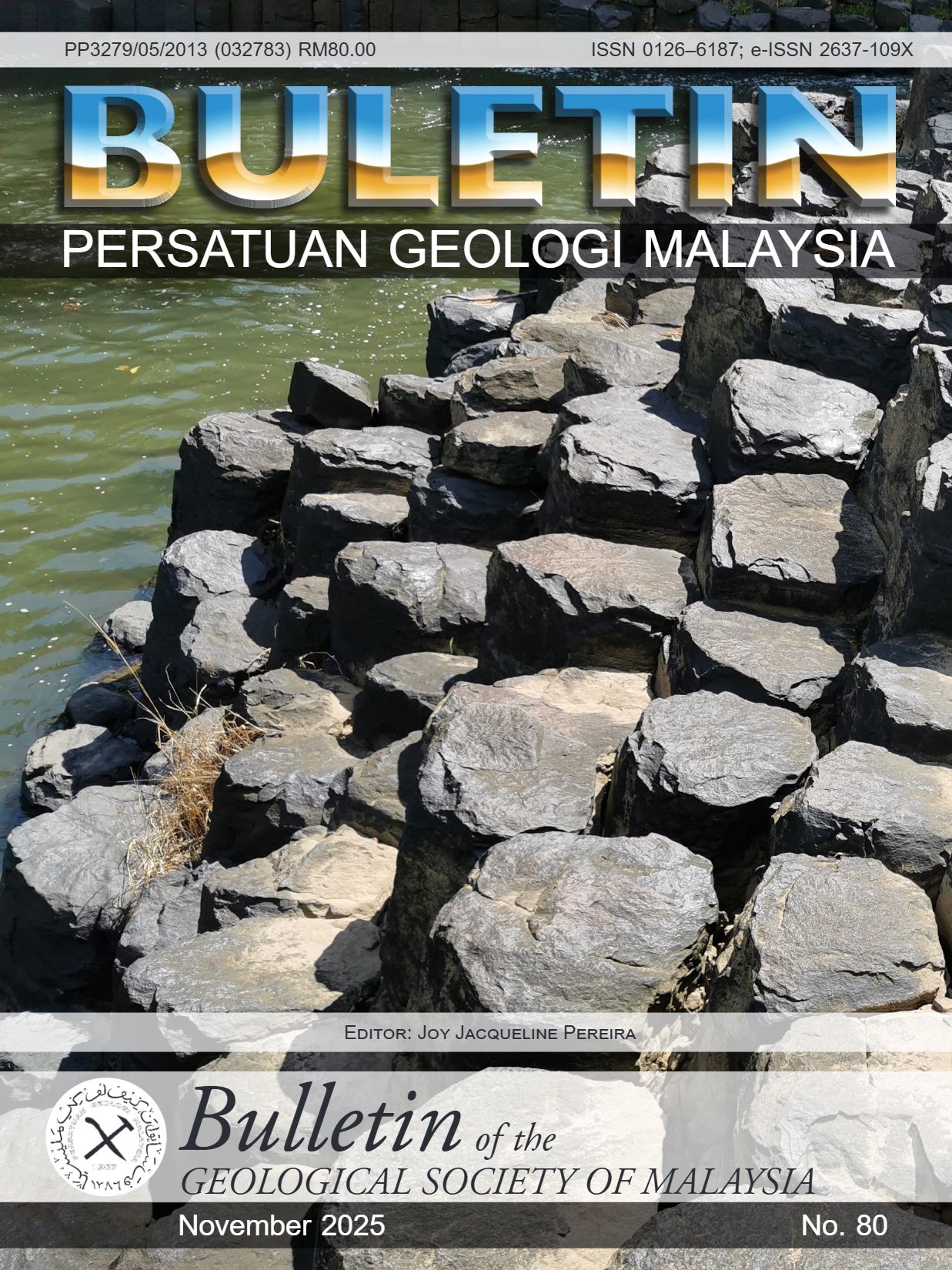

Bulletin of the Geological Society of Malaysia, Volume 80, November 2025, pp. 45 – 57
Late Quaternary denudational chronology of the Kampung Air Jernih area, Terengganu, Malaysia
John Kuna Raj
No. 83, Jalan Burhanuddin Helmi 2, Taman Tun Dr. Ismail, 60000 Kuala Lumpur, Malaysia
Author email address: jkr.ttdi.tmc@gmail.com
Abstract: Four geomorphological units with distinctive subsurface earth materials were identified in the Kampung Air Jernih area, i.e., flood-plains and swamps over Holocene Beruas Formation sediments (3-8 m thick), river terraces over Pleistocene Simpang Formation sediments (3-6 m thick), and denudational terrain over Carboniferous meta-sediments (Sungai Perlis Beds), and over Triassic granite. The flood-plains and swamps are 5 to 8 m above mean sea-level, the terraces between 9 and 15 m, and the denudational terrain above the 15 m topographic contour. Three main rivers are present; the south flowing Sungai Air Jernih, and Sungai Payuh, in the western, and central, sectors, respectively, and the east flowing Sungai Tumpat in the northern sector. Correlation with Quaternary global sea-levels indicates that denudational processes under a tropical savanna climate were operative from circa 500 ka to circa 140 ka BP; the global sea-level rise (Termination II) from -120 m (circa 140 ka) to +6 m (circa 120 ka) giving rise to a tropical rainforest climate and deposition of Simpang Formation sediments by south flowing rivers. The global sea-level fall from +6 m (circa 120 ka) to -120 m (circa 20 ka) led to denudational processes under a tropical savanna climate and formation of river terraces, as well as capture of Sungai Tumpat by the east flowing Sungai Kemasik. Global sea-level rise (Termination I) from -120 m (circa 20 ka) to +5 m (circa 5 ka) led to a tropical rainforest climate and deposition of Beruas Formation sediments followed by down-cutting of rivers from circa 5 ka to the present day. It is concluded that correlating the development of landforms and river capture with Quaternary global sea-levels that allowed for derivation of the denudational chronology.
Keywords: Denudational chronology, Late Quaternary global sea-levels, river capture, Kampung Air Jernih
References
Allaby, M., 2008. A Dictionary of Earth Sciences (3rd Edition). Oxford University Press, Oxford. 654 p.
Alqahtani, F.A., Johnson, H.D., Jackson, C.A.L. & Mohd Rapin B Som, 2015. Nature, origin and evolution of a Late Pleistocene incised valley-fill, Sunda Shelf, Southeast Asia. Sedimentology, 62, 1198-1232.
Azman, A.G., 2009. Plutonism. In: Hutchison, C.S. & D.N.K. Tan (Eds.), Geology of Peninsular Malaysia. University of Malaya & Geological Society of Malaysia, Kuala Lumpur, 211-232.
Batchelor, B., 1979. Discontinuously rising Late Cainozioc eustatic sea levels with special reference to Sundaland, Southeast Asia. Geologi Mijnbouw, 58, 1-20.
Bird, M.I., Taylor, D. & Hunt, C., 2005. Palaeoenvironments of insular Southeast Asia during the Last Glacial Period: a savanna corridor in Sundaland? Quaternary Science Reviews, 24, 2228-2242.
Bosch, J.H.A., 1988. The Quaternary Deposits in the Coastal Plains of Peninsular Malaysia. Geological Survey of Malaysia, Quaternary Geology Section, Report QG/1, Kuala Lumpur. 87 p.
De Dapper, M., 1989. Late Quaternary Geomorphological Evolution in The Uplands of Peninsular Malaysia. Dissertation, Academie Royale des Sciences D’outre-Mer, Brussels. 147 p.
De Dapper, M. & Debaveye, J., 1986. Geomorphology and soils of the Padang Terap District, Kedah. Peninsular Malaysia. Bulletin of the Geological Society of Malaysia, 20, 765-790.
Douglas, I., 1969. The efficiency of humid tropical denudation systems. Transactions Institute of British Geographers, 40, 1-16.
Fateh Chand, 1978. The Geology and Mineral Resources of the Ulu Paka Area, Trengganu. District Memoir 16. Geological Survey of Malaysia, Kuala Lumpur. 124 p.
Fenley, J.R. & Morley, R.J., 1978. A minimum age for the deglaciation of Mount Kinabalu, East Malaysia. Modern Quaternary Research Southeast Asia, 4, 57-61.
Goh, S.T., 1972. Geology of the Kemaman area, Terengganu, Peninsular Malaysia. Bachelor of Science Thesis, Department of Geology. University of Malaya, Kuala Lumpur. 70 p.
Jones, D.K.C., 2004. Cycle of erosion. In: Goudie, A.S. (Ed.), Encyclopedia of Geomorphology. Routledge, London. 244–248.
Kamaludin, B.H., 1989. Significance of palynology in Late Quaternary sediments in Peninsular Malaysia. Bulletin of the Geological Society of Malaysia, 24, 57-66.
Koopmans, B.N. & Stauffer, P.H., 1967. Glacial phenomena on Mount Kinabalu, Sabah. Bulletin Geological Survey Department, Malaysia Borneo Region, 8, 25-35.
Liu, Z., Trentesaux, A., Clemens, S.C., Colin, C., Wang, P., Huong, B. & Boulay, S., 2003. Clay mineral assemblages in the northern South China Sea: implications for East Asian monsoon evolution over the past 2 million years. Marine Geology, 201, 133-146.
Loh C.H., 1992. Quaternary Geology of the Teluk Intan Area, Perak Darul Ridzuan. Quaternary Geology Bulletin 3, Geological Survey of Malaysia, Kuala Lumpur. 46 p.
MetMy (Meteorology Department Malaysia), 2023. https://www. met.gov.my /en /pendidikan /iklim-malaysia/.
Mohd Farid, B.H.S., 2001. Geologi am dengan penekanan kepada mendapan sedimen tak terkonsolidat Kampung Air Jernih, Kemasik, Kemaman, Terengganu. Bachelor of Science Project Report, Department of Geology, University of Malaya, Kuala Lumpur. 36 p.
Morgan, R.P.C., 1973. Soil-slope relationships in the lowlands of Selangor and Negeri Sembilan, West Malaysia. Zeitschrift fur Geomorfologie, 17, 2, 139-155.
Panton, Wm.P., 1958. Reconnaissance Soil Survey of Trengganu. Bulletin 105, Department of Agriculture, Federation of Malaya, Kuala Lumpur. 59 p.
Parham, P.R., 2016. Late Cenozoic relative sea-level high-stand record from Peninsular Malaysia and Malaysian Borneo: Implications for vertical crustal movements. Bulletin of the Geological Society of Malaysia, 62, 91–115.
Railsback, L.B., Gibbard, P.L., Head, M.J., Voarintsoa, N.R.G. & Toucanne, S., 2015. An optimized scheme of lettered marine isotope substages for the last 1.0 million years, and the climato-stratigraphic nature of isotope stages and substages. Quaternary Science Reviews, 111, 94-106.
Suntharalingm, T., 1987. Quaternary Geology of the Coastal Plain of Beruas, Perak. Quaternary Geology Bulletin 2. Geological Survey of Malaysia, Ipoh. 70 p.
Sun, X., Luo,Y., Huang, F., Tian, J. & Wang, P. 2003. Deep-sea pollen from the South China Sea: Pleistocene indicators of East Asian monsoon. Marine Geology, 201, 97-118.
Swan, S.B.St.C., 1972. Land surface evolution and related problems with reference to a humid tropical region, Johor, Malaya. Zeitschrift fur Geomorfologie, 16, 2, 160-181.
Tyebally Fazle Hussein, 1977. Geology of the Chukai area, Sheet 73. Annual Report for 1976. Geological Survey of Malaysia, Government Printing Office, Kuching, 113-116.
Verstappen, H.Th., 1975. On palaeoclimates and landform development in Malesia. In: Bartstra, G., & Casperie, W.A. (Eds.), Modern Quaternary research in Southeast Asia. Balkema, Rotterdam, 3–35.
Verstappen, H.Th., 1997. The effect of climatic change on south-east Asian geomorphology. Journal of Quaternary Science, 12, 413–418.
Wang, L., Sarnthein, M., Erlenkeuser, H., Grimalt, J., Grootes, P., Heilig, S., Ivanova, E., Kienast, M., Pelejero, C., & Pflaumann, U., 1999. East Asian monsoon climate during the Late Pleistocene: high-resolution sediment records from the South China Sea. Marine Geology, 156, 245-284.
Wust, R.A.J. & Bustin, R.M., 2004. Late Pleistocene and Holocene development of the interior peat-accumulating basin of tropical Tasek Bera, Peninsular Malaysia. Palaeogeography, Palaeoclimatology, Palaeoecology, 211, 241-270.
Yap, L.S., 1976. Geology of the Tanjung Gelang area, Pahang. Bachelor of Science Thesis. Department of Geology, University of Malaya, Kuala Lumpur. 66 p.
Yew, C.C., 1974. Geology of the Chukai area, Sheet 73. Annual Report for 1973, Geological Survey of Malaysia. Government Printing Office, Kuching, 129-133.
Manuscript received 14 October 2024;
Received in revised form 13 December 2024;
Accepted 20 February 2025
Available online 28 November 2025
https://doi.org/10.7186/bgsm80202504
0126-6187; 2637-109X / Published by the Geological Society of Malaysia.
© 2025 by the Author(s). This is an open access article distributed under the terms of the Creative Commons Attribution (CC-BY) License 4.0.