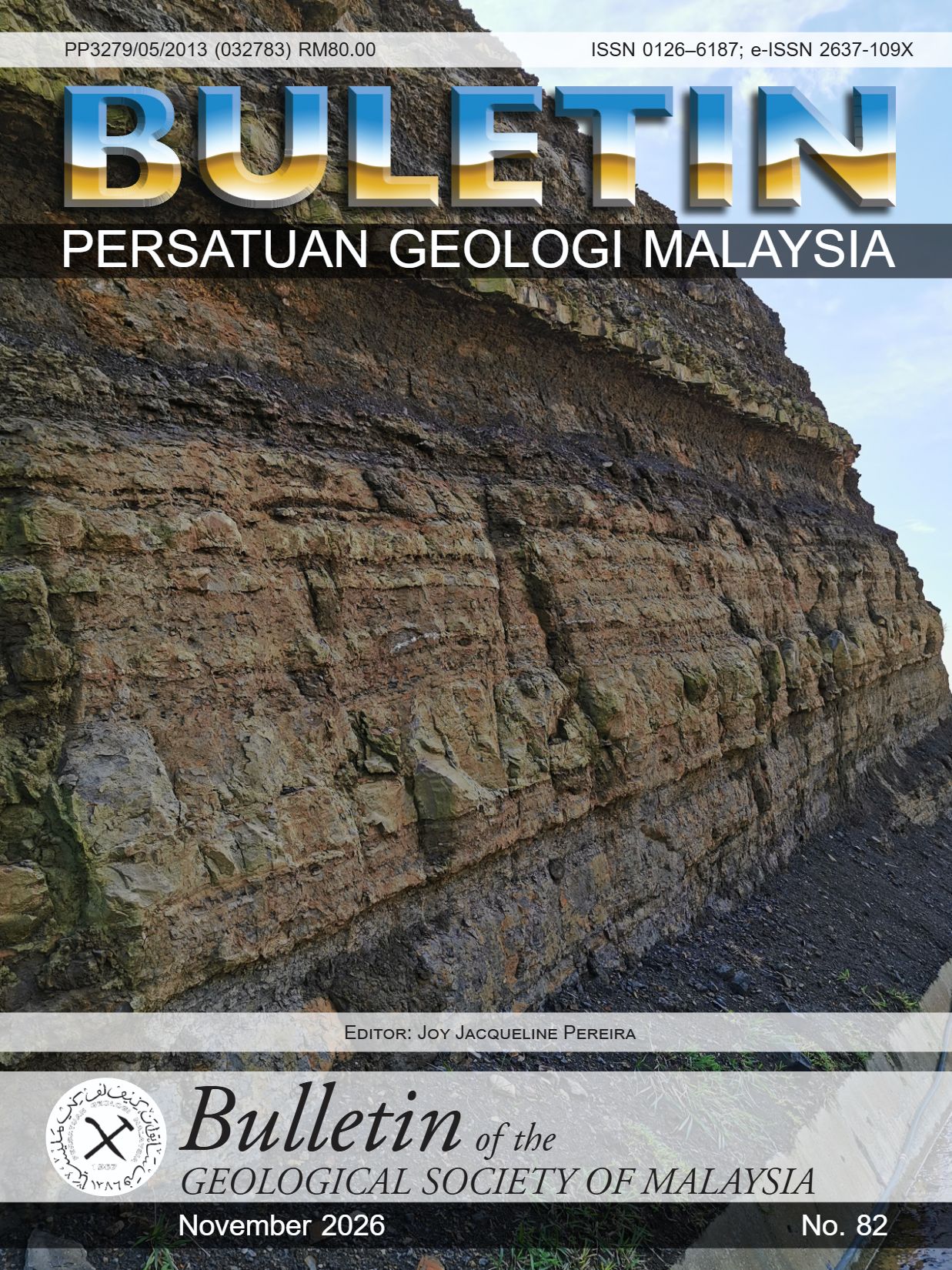

Bulletin of the Geological Society of Malaysia, Volume 82, November 2026, 103-112
The significance of shark tooth from the Late Miocene Tukau Formation, northwest Sarawak, Malaysia
Yi Ning Fong*, Dominique Dodge-Wan, Prasanna Mohan Viswanathan
Department of Applied Sciences, Faculty of Engineering and Science, Curtin University Malaysia,
CDT 250, 98009 Miri, Sarawak, Malaysia
* Corresponding author email address: yn0503@live.com
Abstract: An incomplete shark tooth was discovered from the Late Miocene Tukau Formation outcrop along the Sungai Rait Road in the Miri region, Sarawak, Malaysia. The specimen represents the first documented occurrence of vertebrate remains from the formation, which was referred to as the “Barren Series” due to the absence of fossils in most samples. Previous studies have reported limited brackish water foraminifera with no biostratigraphic value. The discovery of the fossil could help with the reconstruction of the palaeoenvironment of the formation. The shark tooth was recovered from a muddy heterolithic bed at a log height of 17.6 m above the base of the sequence at the outcrop. The tooth specimen is an upper right lateral tooth belonging to the genus Carcharhinus (Carcharhiniformes, Carcharhinidae) based on its overall morphology. A detailed comparison of its morphological features with specimens from previous studies suggests that the tooth may belong to one of the following potential species: C. amboinensis, C. leucas, or C. limbatus. These shark species are commonly found in continental and insular shelf waters, often nearshore, in estuaries, bays, lagoons, and coastal environments, with some species tolerating varying salinities or migrating seasonally. Bulk sampling could be envisaged to gain further knowledge of the vertebrate fossil record from the Tukau Formation.
Keywords: Clastic sediments, Carcharhinus, tooth morphology, Miri
References
Banda, R.M. & Honza, E., 1997. Miocene stratigraphy of Northwest Borneo Basin. Bulletin of the Geological Society Malaysia, 40, 1-11. https://doi.org/10.7186/bgsm40199701.
Berkovitz, B. & Shellis, P., 2023. Chapter 2 – Chondrichthyes 1. Sharks. In: Berkovitz, B. & Shellis, P. (Eds.), The Teeth of Non-Mammalian Vertebrates (Second Edition). Academic Press, Cambridge. https://doi.org/10.1016/B978-0-323-91789-6.00008-X.
Brett, C.E. & Thomka, J.R., 2013. Fossils and Fossilisation. In: Encyclopedia of Life Sciences. John Wiley & Sons, Ltd., Chichester. https://doi.org/10.1002/9780470015902.a0001621.pub2.
Briggs, D.E.G., 2003. The Role of Decay and Mineralization in the Preservation of Soft-Bodied Fossils. Annual Review of Earth and Planetary Sciences, 31, 275-301. https://doi.org/10.1146/annurev.earth.31.100901.144746.
Cappetta, H., 2012. Handbook of Paleoichthyology, Vol. 3E: Chondrichthyes Mesozoic and Cenozoic Elasmobranchii: Teeth. Verlag Dr Friedrich Pfeil, München. 512 p.
Chappell, A. & Seret, B., 2020. Functional Morphology of the Feeding Apparatus of Snaggletooth Shark, Hemipristis elongata (Carcharhiniformes: Hemigaleidae). Journal of Anatomy, 238(2), 288-307. https://doi.org/10.1111/joa.13313.
Collareta, A., Kindlimann, R., Baglioni, A., Landini, W., Sarti, G., Altamirano, A., Urbina, M. & Bianucci, G., 2022. Dental Morphology, Palaeoecology and Palaeobiogeographic Significance of a New Species of Requiem Shark (Genus Carcharhinus) from the Lower Miocene of Peru (East Pisco Basin, Chilcatay Formation). Journal of Marine Science and Engineering, 10, 1466. https://doi.org/10.3390/jmse10101466.
Collins, D.S., Johnson, H.D., Allison, P.A. & Damit, A.R., 2018. Mixed process, humid-tropical, shoreline–shelf deposition and preservation: Middle Miocene–Modern Baram Delta Province, Northwest Borneo. Journal of Sedimentary Research, 88, 399-430. https://doi.org/10.2110/jsr.2018.19.
Collins, D.S., Johnson, H.D., Allison, P.A., Guilpain, P. & Damit, A.R., 2017. Coupled ‘storm‐flood’depositional model: Application to the Miocene–Modern Baram Delta Province, Northwest Borneo. Sedimentology, 64, 1203-1235. https://doi.org/10.1111/sed.12316.
Collins, D.S., Johnson, H.D. & Baldwin, C.T., 2020. Architecture and preservation in the fluvial to marine transition zone of a mixed-process humid-tropical delta: Middle Miocene Lambir Formation, Baram Delta Province, Northwest Borneo. Sedimentology, 67, 1-46. https://doi.org/10.1111/sed.12622.
Compagno, L.J.V., Dando, M. & Fowler, S.L., 2005. A field guide to the sharks of the world. Harper Collins Publishers, London. 368 p.
Ebert, D.A., Dando, M. & Fowler, S., 2021. Sharks of the World: A complete guide. University Press, Princeton. 608 p. https://doi.org/10.2307/j.ctv1574pqp.
Fong, Y.N., Dodge-Wan, D. & Prasanna, M.V., 2024. Observations on palynology of the Tukau Formation in northwest Sarawak, Malaysia. Bulletin of the Geological Society of Malaysia, 78, 75-90. https://doi.org/10.7186/bgsm78202407.
Froese, R. & Pauly, D., 2024., FishBase. World Wide Web electronic publication. www.fishbase.org. Accessed 16 June 2024.
Garrick, J.A.F., 1982. Sharks of the genus Carcharhinus. U.S. National Marine Fisheries Service, United States. 209 p.
Garrick, J.A.F., 1985. Additions to a revision of the shark genus Carcharhinus : Synonymy of Aprionodon and Hypoprion, and description of a new species of Carcharhinus (Carcharhinidae). U. S. D. o. Commerce, United States. 32 p. https://spo.nmfs.noaa.gov/Technical%20Report/tr34opt.pdf.
Hasan, V., Samitra, D., Widodo, M.S. & Gausmann, P., 2021. A new inland record of the bull shark Carcharhinus leucas (Müller & Henle 1839) from Peninsular Malaysia. Sains Malaysiana, 50, 3153-3158. http://doi.org/10.17576/jsm-2021-5010-26.
Hutchison, C.S., 2005. Geology of North-West Borneo, Elsevier, Amsterdam. 444 p. https://doi.org/10.1016/B978-044451998-6/.
James, D.M.D., 1984. Geology and hydrocarbon resources of Negara Brunei Darussalam. Muzium Brunei, Brunei. 169 p.
Jong, J. & Kessler, F.-L., 2019. The Setap Shale Formation on either side of the Baram Line Divide: Facies aspects and tectonic implications. Bulletin of the Geological Society of Malaysia, 67, 53-65. https://doi.org/10.7186/bgsm67201907.
Kessler, F.-L., Jong, J. & Nagarajan, R., 2023. Synopsis of Upper Tukau Deposits along the Sungai Rait Road, Miri District, Sarawak, Malaysia. Bulletin of the Geological Society of Malaysia, 75, 73-84. https://doi.org/10.7186/bgsm75202307.
Kocsis, L., 2024. The Elasmobranch Fossil Record of the Indo-Australian Archipelago since the Miocene: A Literature Review and New Discoveries from Northern Borneo. Diversity, 16, 323. https://doi.org/10.3390/d16060323.
Kocsis, L., Botfalvai, G., Qamarina, Q., Razak, H., Király, E., Lugli, F., Wings, O., Lambertz, M., Raven, H., Briguglio, A. & Rabi, M., 2021. Geochemical analyses suggest stratigraphic origin and late Miocene age of reworked vertebrate remains from Penanjong Beach in Brunei Darussalam (Borneo). Historical Biology, 33, 2627-2638. https://doi.org/10.1080/08912963.2020.1819999.
Kocsis, L., Razak, H., Briguglio, A. & Szabó, M., 2019. First report on a diverse Neogene cartilaginous fish fauna from Borneo (Ambug Hill, Brunei Darussalam). Journal of Systematic Palaeontology, 17, 791-819. https://doi.org/10.1080/14772019.2018.1468830.
Lee, C.P., Leman, M.S., Kamaludin, H., Bahari, M.N. & Rashidah, K., 2004. Stratigraphic lexicon of Malaysia. Geological Society of Malaysia, Kuala Lumpur. 176 p. https://gsm.org.my/articles/702001-101655/.
Liechti, P., Roe, F.W., Haile, N.S. & Kirk, H.J.C., 1960. The geology of Sarawak, Brunei and the Western part of North Borneo, U.S. Government Printing Office, Sarawak. 360 p.
Lin, C.Y., Lin, C.H. & Shimada, K., 2022. A previously overlooked, highly diverse early Pleistocene elasmobranch assemblage from southern Taiwan. PeerJ, 10, e14190. https://doi.org/10.7717/peerj.14190.
Madon, M.B.H., 1999. Geological setting of Sarawak. In: Leong, K.M. (Ed.), The petroleum geology and resources of Malaysia. PETRONAS, Kuala Lumpur. 665 p. ISBN 9839738100.
Malyshkina, T.P., Ward, D.J., Nazarkin, M.V., Nam, G.-S., Kwon, S.-H., Lee, J.-H., Kim, T.-W., Kim, D.-K. & Baek, D.-S., 2023. Miocene Elasmobranchii from the Duho Formation, South Korea. Historical Biology, 35, 1726-1741. https://doi.org/10.1080/08912963.2022.2110870.
Marsili, S., 2007. Revision of the teeth of the genus Carcharhinus (Elasmobranchii; Carcharhinidae) from the Pliocene of Tuscany, Italy. Rivista Italiana di Paleontologia e Stratigrafia, 113, 79-95. https://doi.org/10.13130/2039-4942/6360.
Mediodia, D., Castro, A., Tablizo, M., Policarpio, D., Calvelo, J., Baguio, J.P., Borja, A., Lin, C.-H. & Fernando, A.G., 2025. Paleoichthyology in the Philippines: A review of Cenozoic fish fossils with insights on its current status and future opportunities. Geobios, 88-89, 163-174. https://doi.org/10.1016/j.geobios.2024.02.006.
Miller, M.H., Carlson, J.K., Cooper, P.W., Kobayashi, D.R., Nammack, M. & Wilson, J., 2014. Status review report: scalloped hammerhead shark (Sphyrna lewini). National Marine Fisheries Service National Oceanic and Atmospheric Administration, Silver Spring. 131 p.
Munsell, A.H., 2000. Munsell soil color charts. GretagMacbeth, New Windsor, N.Y. 10 p.
Nagarajan, R., Roy, P.D., Kessler, F.-L., Jong, J., Dayong, V. & Jonathan, M.P., 2017. An integrated study of geochemistry and mineralogy of the Upper Tukau Formation, Borneo Island (East Malaysia): Sediment provenance, depositional setting and tectonic implications. Journal of Asian Earth Sciences, 143, 77-94. https://doi.org/10.1016/j.jseaes.2017.04.002.
Naylor, G.J.P., 1992. The phylogenetic relationships among requiem and hammerhead sharks: Inferring phylogeny when thousands of equally most parsimonious trees result. Cladistics, 8, 295-318. https://doi.org/10.1111/j.1096-0031.1992.tb00073.x.
Naylor, G.J.P. & Marcus, L.F., 1994. Identifying isolated shark teeth of the genus Carcharhinus to species : Relevance for tracking phyletic change through the fossil record. American Museum Novitates, 3109, 53.
Purdy, R.W., 2006. A key to the common genera of Neogene shark teeth. Smithsonian Institution, Washington DC. 29 p.
Purdy, R.W., Schneider, V.P., Applegate, S.P., Meyer, R.L. & Slaughter, B.H., 2001. The Neogene sharks, rays, and bony fishes from Lee Creek Mine, Aurora, North Carolina. Geology and Paleontology of the Lee Creek Mine, North Carolina, 90, 71-202. https://www.biodiversitylibrary.org/item/266340.
Razak, H. & Kocsis, L., 2018. Late Miocene Otodus (Megaselachus) megalodon from Brunei Darussalam: Body length estimation and habitat reconstruction. Neues Jahrbuch für Geologie und Paläontologie Abhandlungen, 288, 299-306. https://doi.org/10.1127/njgpa/2018/0743.
Sandal, S.T., 1996. The geology and hydrocarbon resources of Negara Brunei Darussalam. Brunei Shell Petroleum Company Sendrian Berhard, Brunei Museum /Brunei Darussalam & Syabas, Brunei Darussalam. 243 p. https://books.google.com.my/books?id=Lr1-AAAACAAJ.
Togunwa, O.S. & Abdullah, W.H., 2017. Geochemical characterization of Neogene sediments from onshore West Baram Delta Province, Sarawak: Paleoenvironment, source input and thermal maturity. Open Geosciences, 9, 302-313. https://doi.org/10.1515/geo-2017-0025.
Togunwa, O.S., Abdullah, W.H., Hakimi, M.H. & Barbeito, P.J., 2015. Organic geochemical and petrographic characteristics of Neogene organic-rich sediments from the onshore West Baram Delta Province, Sarawak Basin: Implications for source rocks and hydrocarbon generation potential. Marine and Petroleum Geology, 63, 115-126. https://doi.org/10.1016/j.marpetgeo.2015.02.032.
Underwood, C.J., Johanson, Z., Welten, M., Metscher, B., Rasch, L.J., Fraser, G.J. & Smith, M.M., 2015. Development and Evolution of Dentition Pattern and Tooth Order in the Skates And Rays (Batoidea; Chondrichthyes). PLOS ONE, 10, e0122553. https://doi.org/10.1371/journal.pone.0122553.
Villafaña, J.A., Marramà, G., Klug, S., Pollerspöck, J., Balsberger, M., Rivadeneira, M. & Kriwet, J., 2020. Sharks, rays and skates (Chondrichthyes, Elasmobranchii) from the Upper Marine Molasse (middle Burdigalian, early Miocene) of the Simssee area (Bavaria, Germany), with comments on palaeogeographic and ecological patterns. PalZ, 94, 725-757. https://doi.org/10.1007/s12542-020-00518-7.
Wannier, M., Lesslar, P.H., Lee, C.H., Raven, H., Sorkhabi, R. & Ibrahim, A., 2011. Geological excursions around Miri, Sarawak. EcoMedia, Miri. 279 p.
Wilford, G.E., 1961. The geology and mineral resources of Brunei and adjacent parts of Sarawak: With descriptions of Seria and Miri Oilfields. Brunei Press, Brunei. 319 p. https://books.google.com.my/books?id=rZbqPQAACAAJ.
Zougrou, I.M., Katsikini, M., Pinakidou, F., Papadopoulou, L., Tsoukala, E. & Paloura, E.C., 2014. Influence of depositional environment in fossil teeth: a micro-XRF and XAFS study. Journal of Physics: Conference Series, 499, 012015. https://doi.org/10.1088/1742-6596/499/1/012015.
Manuscript received 6 May 2025;
Received in revised form 5 September 2025;
Accepted 2 December 2025
Available online 27 November 2026
https://doi.org/10.7186/bgsm82202609
0126-6187; 2637-109X / Published by the Geological Society of Malaysia.
© 2026 by the Author(s). This is an open access article distributed under the terms of the Creative Commons Attribution (CC-BY) License 4.0.